Thursday, October 30, 2008

okay. i lied. i promise that this is my last presidential election post


i first learned about john mccain about four years ago after seeing him in the documentary why we fight. i admired his willingness to openly criticize the military industrial complex and the bush administration's involvement with it. following this, i learned more about mccain's heroic efforts in vietnam and his fight for ethics reform as a senator. looking back i learned more of his relatively clean campaign in the 2000 primaries despite the bush campaign's turn to personal smears, false allegations, and racist attacks. i also learned of his open criticisms of bush's economic policies and continued push for ethic reforms. i found myself wanting him to be the republican candidate in case the gop won the white house.

in today's harsh political climate i think we tend to forget that the opposing candidate may have much to offer our country and would not be in their position if they didn't have the country and its citizens well being in mind.

*****FACEBOOK USERS - PLEASE LEAVE YOUR COMMENTS ON THE ORIGINAL POST BY CLICKING 'View original post' BELOW*****

Wednesday, October 29, 2008

my final presidential elections post


two years ago last week i wrote my first blog post about barack obama. you can read it here. i had just read a time magazine article about his potential run(pictured above), along with a selection of his second book, and found myself an instant fan. since that time i have read both his books, dozens of articles, and nearly every argument for and against him i could find. i watched as he was considering his candidacy, watched almost every debate of the primaries (both democratic and republican), watched him become the dnc candidate, followed every minute of the general elections, and am now writing this final post before the elections next week.

tonight, and almost two years later after i first really learned about him, obama gave his final argument for his vote. if you haven't seen it yet, i encourage you to.


all too often i am accused of blindly following him by those who have never once considered voting outside of their family gop-loyalties and who haven't spent more than a few minutes in total researching the elections. i have been told time and time again that i am supporting someone who they claim goes against everything i should be believing as a christian and latter-day saint.

these are my final words - as abstract as they may be:

i believe it is urgent that we seek measures to get out of a war that has killed thousands of americans, hundreds of thousands of innocent, and has wasted billions of dollars. i believe that we need to establish economic plans that seek to help out those who are truly in need. i believe we need to seek health care plans that best help those who are sick and cannot afford the medical aid to live. i believe we need to create a society that grants equality to all and doesn't discriminate because on race, ethnicity, religion, or gender. i believe this largely because of the values i was raised with. i believe that the needs to find peace, help the poor, heal the sick, and lift the oppressed are not only the ideals that we should share as americans, but are the ideals we are taught to hold as christians and latter-day saints.

how you may vote is obviously up to you. it is each of our duty as americans to inform ourselves as much as possible before we vote. the life of our nation depends on it. if you haven't yet, i encourage you to really look at the candidates and their platforms. ignore the negative attacks that they (and i) have been pushing, and ask yourself which candidate is it that best aligns with your ideals, faith, and goals for our nation.

and then vote.


*****FACEBOOK USERS - PLEASE LEAVE YOUR COMMENTS ON THE ORIGINAL POST BY CLICKING 'View original post' BELOW*****

Tuesday, October 28, 2008

david sedaris - undecided

this is for jack and jeff and any other david sedaris fans out there... as well as for those odd undecideds who are still lurking out in the woods.
~~~~~~~~~~~~~~~~~~~~~~~~~~~~~~~~~~~~~~~~~~~~

"I don’t know that it was always this way, but, for as long as I can remember, just as we move into the final weeks of the Presidential campaign the focus shifts to the undecided voters. “Who are they?” the news anchors ask. “And how might they determine the outcome of this election?”

"Then you’ll see this man or woman— someone, I always think, who looks very happy to be on TV. “Well, Charlie,” they say, “I’ve gone back and forth on the issues and whatnot, but I just can’t seem to make up my mind!” Some insist that there’s very little difference between candidate A and candidate B. Others claim that they’re with A on defense and health care but are leaning toward B when it comes to the economy.
I look at these people and can’t quite believe that they exist. Are they professional actors? I wonder. Or are they simply laymen who want a lot of attention?

"To put them in perspective, I think of being on an airplane. The flight attendant comes down the aisle with her food cart and, eventually, parks it beside my seat. “Can I interest you in the chicken?” she asks. “Or would you prefer the platter of shit with bits of broken glass in it?”

"To be undecided in this election is to pause for a moment and then ask how the chicken is cooked. . . ."


read the rest here.


*****FACEBOOK USERS - PLEASE LEAVE YOUR COMMENTS ON THE ORIGINAL POST BY CLICKING 'View original post' BELOW*****

Sunday, October 26, 2008

"And who is my enemy?" (a sunday talk)

this is a talk i'll be giving in sacrament meeting tomorrow. a sneak peek for those who read it before 1pm.
~~~~~~~~~~~~~~~~~~~~~~~~~~~~~~~~~~~~~~~~~~~~~~~~~~~~~~~~~~~~~~~~~~~~~~

And, behold, a certain lawyer stood up, and tempted him, saying, Master, what shall I do to inherit eternal life?
[Jesus] said unto him, What is written in the law? how readest thou?
And he answering said, Thou shalt love the Lord thy God with all thy heart, and with all thy soul, and with all thy strength, and with all thy mind; and thy neighbour as thyself.
And [Jesus] said unto him, Thou hast answered right: this do, and thou shalt live.
But [the lawyer], willing to justify himself, said unto Jesus, And who is my neighbour?

“And who is my neighbor?” Before we go to Jesus' response let's look at how we might normally respond to this question. It seems like a rather easy one to answer – After all, we were taught as children along with the alphabet, numbers, shapes, the fact that cookies are desirable, and what a snuffleupagus is, by Sesame Street just “who are the people in your neighborhood?”

Well, they're the people that you meet
When you're walking down the street
They're the people that you meet each day

This is how we usually define 'who is my neighbor.' They are the people that we meet each day.

However if we look at Jesus' mortal ministry we can readily see that those he paid the most attention to were not the people that we normally meet each day – rather, it was those that we don't see each day. He spent his time going to the socially outcast, the other. These were the poor, the sick, the mentally ill, the prostitute, the Samaritan woman at the well, and the woman suffering from bleeding. In fact, in the Gospels Jesus pays special attention to women, who were normally among the social outcasts in the largely patriarchal culture of his day. The Pharisees even used Jesus' close relationship with the outcasts in their attempts to discredit the Savior by pointing out that he ate and drank with the lower publicans and sinners.

During his ministry Jesus did not limit his neighbors to those we would normally think of, but made sure to extend his neighborhood to include those who all others usually excluded. Perhaps if Jesus worked for Sesame Street we might sing, “Who are the people in your neighborhood? They're the people you avoid each day.”

But Jesus didn't stop here with those we should include as our neighbors. In the Sermon on the Mount, Jesus taught:
Ye have heard that it hath been said, Thou shalt love thy neighbour, and hate thine enemy.
But I say unto you, Love your enemies, bless them that curse you, do good to them that hate you, and pray for them which despitefully use you, and persecute you;
That ye may be the children of your Father which is in heaven: for he maketh his sun to rise on the evil and on the good, and sendeth rain on the just and on the unjust.
For if ye love them which love you, what reward have ye? do not even the publicans the same?
And if ye salute your brethren only, what do ye more than others? do not even the publicans so?
Luke has it recorded a little differently:
And as ye would that men should do to you, do ye also to them likewise.
For if ye love them which love you, what thank have ye? for sinners also love those that love them.
And if ye do good to them which do good to you, what thank have ye? for sinners also do even the same. . . .
But love ye your enemies, and do good, . . . hoping for nothing again; and your reward shall be great, and ye shall be the children of the Highest: for he is kind unto the unthankful and to the evil.
Be ye therefore merciful, as your Father also is merciful.
Jesus points out that it takes no effort to love those that we normally consider our neighbors. Everybody can and easily does that. Even the publicans – those Roman sympathizers – can do that. Jesus points out that more than just extending our neighborhood from those we meet to those we avoid; we need to extend our neighborhood to include our enemies – those we may normally fear, dislike, or even hate.

This is difficult. Christ is calling us to extend our love to those we perhaps want to love the least. He is asking us to extend our love to those who have hurt or offended us, and who will probably not reciprocate that love in return.

Perhaps then, instead of asking “And who is my neighbor?” our Savior would have us ask, “And who is my enemy?” Because it is by identifying the latter we can know who we ought to be including in the former. In other words, it is by asking “And who is my enemy?” that we can fully realize the breadth of those we should be calling our neighbors.

For some 'enemies' it may be easy to see that we need to extend our neighborhood to include them. These may be those who hold strong theological differences, but where we can empathize with their desire to serve God and others. With the upcoming elections (just a week away) our enemies may be those with major political differences, but with whom we can empathize with their desire to do what they think is best for the nation; Or it may be gay and lesbian couples who hold a different view of what the ideal family may be, but where we can still empathize with their desire to be able to have a secure, accepted, and loving relationship as others are able to enter into.

For other enemies it can be more difficult. On the personal level, it may be those who have belittled or hurt us for no apparent reason, those who have used us for personal gain, or thieves like the person who stole my dear sweet beloved mountain bike while I was attending institute on Wednesday. On a larger scale our enemies may be ideologies that we perceive to threaten our way of life, or terrorists or nations who seek to expand their empire or use violence to force their government and culture on others.

Let's turn back to the conversation we began with between the lawyer and Jesus. In response to the question “And who is my neighbor?” Jesus answers with what is probably the most famous of his parables – the Parable of the Good Samaritan – where we can see him pointing to the more difficult of questions “And who is my enemy?”

Before we read it though – to understand what Jesus was doing here we must understand that in Christ's day if there was any group of people that the Jews despised and hated more than the Romans, it was the Samaritans. And that says a lot as the Jews did not like the Romans. This dislike of the Romans is why the publicans get such a bad rap in the New Testament. More than just being mere 'tax-collectors', the publicans were Jews who sympathized with the Roman oppression and used it to make money through building contracts and other agreements with the Roman oppressors – often to the detriment of their fellow Jews. However as much as the Jews disliked the Romans, they acknowledged that the Roman rule had at least done them some good. As the Peoples Front of Judea determine in Monty Python's The Life of Brian,

“All right, but apart from the sanitation, the medicine, education, wine, public order, irrigation, roads, a fresh water system, and public health, what have the Romans ever done for us?”

The Samaritans, on the other hand, were seen to have nothing to contribute to the Jews and were thought of as a group that could only be hated and despised.
And Jesus answering said, A certain man went down from Jerusalem to Jericho, and fell among thieves, which stripped him of his raiment, and wounded him, and departed, leaving him half dead.
And by chance there came down a certain priest that way: and when he saw him, he passed by on the other side.
And likewise a Levite, when he was at the place, came and looked on him, and passed by on the other side.
But a certain Samaritan, as he journeyed, came where he was: and when he saw him, he had compassion on him,
And went to him, and bound up his wounds, pouring in oil and wine, and set him on his own beast, and brought him to an inn, and took care of him.
And on the morrow when he departed, he took out two pence, and gave them to the host, and said unto him, Take care of him; and whatsoever thou spendest more, when I come again, I will repay thee.
Which now of these three, thinkest thou, was neighbour unto him that fell among the thieves?
And [the lawyer] said, He that shewed mercy on him. Then said Jesus unto him, Go, and do thou likewise.
Jesus does at least three things here by having the protagonist of his parable be a Samaritan. By having him help out and show mercy to the (mostly likely Jewish) victim, Jesus shows that we need to extend our neighborhood across its normal boundaries to include those whom we would normally consider our enemies. Second, by using the Samaritan as the exemplar of mercy and love, Jesus points out how flawed our habits to categorizes and judge others who differ from us are. Finally, by using a Samaritan (as opposed to a Jew), Jesus forces this lawyer to acknowledge that this person whom he would normally hate is really the neighbor he needs to love the most. We can still see the lawyer's unwillingness to accept this fact when he refuses to name the Samaritan in his final answer, but instead identifies him merely as “He that shewed mercy on him.”
Merely identifying our enemies as those whom we ought to include as our neighbors is not enough though. The question that began the discussion with Jesus and culminated in the parable of the Good Samaritan was not “And who is my neighbor?” But was “What shall I do to inherit eternal life?” Jesus' answer was to love God and to love our neighbors, with the Good Samaritan as the example of how this is done. In Matthew 22:35-39 (which is most likely a variant of this same account) Jesus identifies the commandments to love God and our neighbor as the two great commandments. If, as Christ taught in the Sermon on the Mount, that loving our enemy is greater than loving our friend, then we could easily say that the first and great commandment is to “love the Lord thy God with all thy heart, and with all thy soul, and with all thy mind. . . . And the second is like unto it, Thou shalt love thy enemy as thyself.”

What does it mean then to love our enemies? First we need to understand that the commandments to love god and love our enemies are not mutually exclusive commandments. In fact, rather than being different commandments they are essentially the same. In John's Gospel Christ taught “If ye love me, keep my commandments” (John 14:15). Minutes later he clarifies, “This is my commandment, That ye love one another, as I have loved you” (John 15:12). To love God is to love our enemies and to love our enemies is to love God. Jesus again points this out in Matthew 25 where speaks of those who fed the hungry, clothed the naked, took in the strangers, cared for the sick, and visited the criminals in prison and says “Inasmuch as ye have done it unto the lease of these my brethren, ye have done it unto me” (Matt 25:40).

There are many ways that we can love our enemies, each of them different according to the situation. However there are some ways that can be applied to any enemy we choose to embrace and call neighbor.
The first is to not judge. This is often difficult when we know the pain and hurt the guilty enemy has caused. Father Zosima, a priest in Fyodor Dostoevsky's book, The Brothers Karamazov says something about this that have I found to be helpful. He says:
“Above all, remember that you cannot be anyone's judge. No man on earth can judge a criminal until he understands that he himself is just as guilty as the man standing before him and that he may be more responsible than anyone else for the crime . . . For it is possible that, if I myself had been upright, this man would not be standing before me accused of a crime. If you can accept the responsibility for the crime committed by the man standing before you, whom you are judging in your heart, then take the crime upon yourself and pay for it with your suffering and let the accused walk away without reproach. . . .

“If the evil deeds of men sadden you too greatly and arouse in you an anger you cannot overcome and fill you with the desire to wreak vengeance on the evil-doers – fear this feeling most of all, and once go and seek suffering for yourself, because you too are responsible for the evil deeds of all men. Bear that ordeal and your desire for revenge will be quenched when you understand that you were guilty yourself for having failed to shwo the light to the wicked, as a man without sin could. For if you had done so, you would have lighted the path for the sinful, and the criminal might not have committed his crime.”
What Father Zosima is saying is that before we try to judge we need to realize that while we may not have been directly involved with the offender, we have each contributed in some way to a world of sin. Each of us at times has not been a light to others – a role that others have played in our lives in guiding us toward better decisions.

Second, we need to forgive. We need to forgive even when it has not been sought. We need to forgive and trust, especially when those we are forgiving do not deserve it. As my favorite LDS writer Eugene Englad puts it:
“[Trust and forgiveness need] to be extended not because others deserve it but because they need it, because they can become trustworthy (or loving) by being nurtured in a community of trust and love. We need to extend trust, even if doing so makes us vulnerable to pain and great cost, in order to save our own souls.”
This type of forgiveness was portrayed beautifully in Mel Gibson's The Passion of the Christ where our Savior is portrayed forgiving the Roman soldiers and later the Jewish priests “who know not what they do.” And by doing this he extends this forgiveness to each of us who ignorantly contribute to the sins and pains of the world.

Finally we need to try to discover, understand, and help the needs of our enemies. For many this willingness to discover and understand is all that is needed. Too often we mis-characterize those who are different and perhaps ideologically oppose us. Because what they desire may differ from our own, under the banner of self-righteousness we instantly accuse the other of being selfish, malicious, or dangerous. Because we have not tried to love and understand them, we have been unwilling to recognize that they are truly our brothers and sisters and are not our enemies at all.

This is all easy to say, but far more difficult to do. If I am someday able to confront the thief whole stole my bike, could I really love him? I don't know. Christ is asking a lot of me – especially when it most likely won't end with a warm-fuzzy seminary story where the thief turns out to be a poor orphan kid who meant to merely borrow the bike for a few minutes before he had to go back to his foster home where he would be enslaved and beaten. If that were the case, I am sure I could find myself loving him much more easily, perhaps even offering my bike freely to him, and the story would end as President Monson might end it – 'hearts were touched. Tears were shed. And friendships were established that would be eternal.'

Perhaps this is the same difficulty Christ's apostles felt after he commanded the rich young man to sell all he had and give it to the poor, explaining to his disciples that it is easier for a camel to go through the eye of a needle than a rich man to enter the kingdom of heaven. They were astonished. Who could possibly do what Christ asked required of us. Who has the strength to give up all they have to the poor, they wondered. “Who then can be saved?”(Mark 10:26). Similarly we can ask, who of us has the strength to truly love our enemies? If this is a requirement for eternal life, “Who then can be saved?” Jesus' answer remains the same, “With men it is impossible, but not with God: for with God all things are possible” (Mark 10:27).

Alone this is impossible, but with God's love and help we can be able to love our enemies. I urge all of us too ask ourselves, “And who is my enemy?” and then pray for God's assistance to help us reach out and love them, to share that love that Christ has freely given us – even when we have at times been an enemy to him.
I know that God lives and that by him we can know how to love as he does. I now finish with a final song from my childhood that I hope we can extend to those we believe to be our enemies:

So let's make the most of this beautiful day,
Since we're together, we might as well say,
Would you be mine?
Could you be mine?
Won't you be my neighbor?

In the name of Jesus Christ, Amen.


*****FACEBOOK USERS - PLEASE LEAVE YOUR COMMENTS ON THE ORIGINAL POST BY CLICKING 'View original post' BELOW*****

Saturday, October 25, 2008

wassup then and now

then


now


*****FACEBOOK USERS - PLEASE LEAVE YOUR COMMENTS ON THE ORIGINAL POST BY CLICKING 'View original post' BELOW*****

Friday, October 24, 2008

the greatest bi-partisan election video ever!

enjoy


*****FACEBOOK USERS - PLEASE LEAVE YOUR COMMENTS ON THE ORIGINAL POST BY CLICKING 'View original post' BELOW*****

Wednesday, October 22, 2008

my bike was stolen

i rode viggy to institute today. when i got out an hour later he was gone. i locked him up pretty good and whoever stole it would have had to completely remove the cable to ride away with it. since they seemed to have also taken the lock - and it would have been difficult to ride with the eggbeater pedals - my guess is that the lock was cut and they threw viggy in a truck and drove off with him.

viggy wasn't just a bike. when i was clicked into those crankbrother pedals he became an extension of my body. right now i just feel violated and devasted. i had just spend a couple hours touching him up a recently and was all set to hit a trail tomorrow more that i had discovered over the weekend.

this sucks ass.


i want to cry. i can't believe this happened.


*****FACEBOOK USERS - PLEASE LEAVE YOUR COMMENTS ON THE ORIGINAL POST BY CLICKING 'View original post' BELOW*****

Tuesday, October 21, 2008

jon stewart is pissed

in tonight's the daily show, jon stewart made it pretty clear how he feels about the 'pro-america' rhetoric the john SIDNEY mccain, a former prisoner of war, campaign has recently been vomiting out:


*****FACEBOOK USERS - PLEASE LEAVE YOUR COMMENTS ON THE ORIGINAL POST BY CLICKING 'View original post' BELOW*****

Monday, October 20, 2008

yes on prop 8 - #2 same-sex marriage will make homosexuals gay

a few nights ago i came across an old ensign article from 1974 which shed's some light on another reason why same-sex marriages should be banned - the legalization of it will make homosexuals gay.

in the 'i have a question' section of the magazine, the question is asked: "Why does the Church oppose homosexuality? Why is it wrong?"

here is some of the answer:

Homosexuals and lesbians seldom are happy people. Theirs is a relationship that is unnatural, one not bound by fidelity, trust, or loyalty, and one totally lacking in the meaningful family relationships that marriage offers. Homosexuality often espouses emotional problems because of the constant insecurity inherent in a relationship neither sanctioned by nor protected by the law.

Because there is no legal bond, homosexuality too often encourages, or at least permits, promiscuity.

To say that “no one gets hurt” is presumptive. Homosexuals are hurt by the unacceptability of the relationship, not only by society, but also by themselves.
so basically, one of the reasons why homosexuality is wrong is because it is a sad lifestyle. the reason it is a sad lifestyle is because homosexuals are unable to have the same societal acceptance and interrelational security that legal marriage offers.

years ago, homosexuals stole the word 'gay' to describe themselves. while today they may call themselves gay (homosexual) they have not been gay (happy). however, with the legalization of marriage they may soon be able to call themselves gay in both senses of the term.

we cannot let that happen.

the scriptures explicitly teach that "men are, that they might have joy, but not be gay" (2 nephi 2:25). by delegitimizing their relationships we have been able to make sure that  homosexuals were sad and depressed gays, not gay gays.

if being gay is sinful, then being gay gay must be extra sinful. allowing homosexuals to marry each other will allows gays to be gay. and that is certainly something we cannot have.


*****FACEBOOK USERS - PLEASE LEAVE YOUR COMMENTS ON THE ORIGINAL POST BY CLICKING 'View original post' BELOW*****

Sunday, October 19, 2008

yes on prop 8 - #1 protect the divine institution of gender inequality in marriage

in latter-day saint discourse concerning prop 8, there has been much ado with the proclamation on the family's call to maintain the tradtion of different-sex marriage - that marriages should be composed both male and female partners. however there is another tradition that the proclamation calls to maintain - one that may actually affect a heterosexual like me  - and that is the time and divinely honored tradition of gender inequality in marriage.

going even further back than the divine institution of polygamy, the divine instituion of gender inequality in marriage harkens back to the days of adam when eve promised to be submissive to her husband. while polygamy as a divine institution has been done away with (sort of), the church today has continued to call for this divine practice that is often ridiculed by the satan-inspired secular world. through the proclamation and numerous talks, sermons, and articles the church has continually taught that it is god's desire for men to be providefor and to exersize control over his spouse and family, and it is god's desire for women to stay at home breastfeeding, cooking, cleaning, doing the laundry, and whatever else her husband tells her to do as she is being submissive to his will.

what same-sex marriage does is it threatens the divine institution of gender inequality in marriage (and thus threatens me) by claiming that gender inequality is not a necessary part of marriage. if both parties of a marriage are of the same sex, then how can we maintain our divinely inspired tradition of having one be in submission of the other by virtue of their sex. in a same-sex marriage it is impossible for one partner to demand a divine (or natural) right of authority in the relationship based on their different sex.

this is how same-sex marriage is going to destroy the very fabric of marriage (and thus bring in the apocalyptic events prophesied in the day after tomorrow). if prop 8 fails to pass, women throughout california and the world (including my future wife) will be able to tell their husbands, "i don't have to do whatever you tell me just because you are the man and i am the woman in this marriage. gender inequality is not an essential aspect of marriage - just look at bob and steven - they treat each other equally."

for the sake of protecting the divine institution of gender inequality in marriage we need to make sure that prop 8 passes - or how else can we ensure that the dishes and laundry get done?

*perhaps a middle ground could be made by allowing same-sex marriage only when there is a performative gender role in the relationship where one has a more masculine role while the other maintains a more effeminate role; thus maintaining our divine institution of gender inequality in marriage - even when both are of the same sex.

Saturday, October 18, 2008

letter to joe the plumber from mccain leaked!

courtesy of 236.com

Thursday, October 16, 2008

mccain, a former prisoner of war, continues to fuel hatred

today thousands of americans have begun receiving the following automated voice message from the john SIDNEY mccain, a former prisoner of war, campaign:


if that didn't sicken you enough, this is the type of hatred that he, a former prisoner of war, is fueling:

Wednesday, October 15, 2008

the best moment of the debates

john SIDNEY mccain, a former prisoner of war, has had many great moments in the three presidential debates. he had his blinking, his wandering all over the stage, enough fake grins to please any grandmother, his eye rolling, smirks, deep breathing, and of course his blinking.

but tonight's moment beats them all.

a little preface:

the real star of tonight's debate was joe the plumber. i'm not exactly who this guy is, but if he ever gets his plumbing business going he just needs to call it "joe the plumber" and he will bring in millions.

as he has done in previous debates, john SIDNEY mccain, a former prisoner of war, accused obama of fining small business who did not provide health care for their employees. bringing joe back into the debate, mccain, a former prisoner of way, says:

"Now, Joe, Sen. Obama's plan, if you're a small business and . . . if you're out there, my friend, and you've got employees, and you've got kids, if you don't get -- adopt the health care plan that Sen. Obama mandates, he's going to fine you.

"Now, Sen. Obama, I'd like -- still like to know what that fine is going to be, and I don't think that Joe right now wants to pay a fine when he is seeing such difficult times in America's economy."


mccain, a former prisoner of war, is feeling pretty confident now. he's got obama right where he wants him and is sporting a wide grin of confidence.

but wait!

watch mccain, a former prisoner of war, react to obama's answer (especially his eyes).


priceless.


*UPDATE*

i was just pointed out this runner up for the best moment. it was taken right at the end of the debate when mccain, a former prisoner of war, realized he was walking the wrong direction. i think it best describes the debate, as well as this election.

the poor old guy is just lost and confused

john SIDNEY mccain's, a former prisoner of war, 'new' stump speech

another brilliant and humorous analysis from the daily show


and here is a little bonus video from last night.


Tuesday, October 14, 2008

my god is bigger than your god

the following was an invocation made at the beginning of a mccain rally on saturday in iowa, by reverend arnold conrad of bethany baptist church in moline illinois:


poor fellow doesn't know that hindu's don't have a god named 'hindu' nor that buddhists worship some god named 'buddha'.

notice that he didn't mention those who are praying to 'mormon.' that's right. he knows that 'mormon' can totally kick his god's butt.

Monday, October 13, 2008

popped collars

i don't know who this guy is. i just know that he goes to to byu-i and that he pops his collar. i can handle the former, but the latter? seriously? do people actually think it's cool?


i don't have any friends that pop their collars. i don't see why anybody would have friends that do, but just in case you do this is for them.

finally, here is what may be the most important website your friends ever see.

Saturday, October 11, 2008

even more reflections on prop 8

i know i've been writing a lot on this. it's may way of sorting things out in my mind. the following is a comment i left on a previous post, but decided to give a post of its own.
~~~~~~~~~~~~~~~~~~~~~~~~~~~~~~~~~~~~~~~~~~~~~~~~~~~~~~~~~~~~~~~~~~~

ezekial 16:49 teaches us the sin of sodom and gomorroh. it was not homosexuality as homophobic religion has taught for centuries:

"Behold, this was the iniquity of thy sister Sodom, pride, fulness of bread, and abundance of idleness was in her and in her daughters, neither did she strengthen the hand of the poor and needy."

in response to a failed revelation, joseph smith said "some revelations are of god, some revelations are of me, and some revelations are of the devil." i believe strongly that joseph smith was a prophet of god, just as i believe that thomas s. monson is today. however, i also believe that they are human beings and struggle, just as i do, to understand the will of god.

i believe that it is important to protect families. i have no doubt that my prophets feel inspired that the lord desperately wants to protect families. however, i feel also feel that there are better and more important ways than this. there are much larger threats facing the family than two people who love each other.

church leaders have made mistakes in the past. church leaders have made mistakes in the past in the name of god. for over a hundred years, as a church, we discriminated against a large group of god's children because of the color of their skin. it was wrong. brigham young was wrong. but i believe he was a prophet nonetheless.

this is a mistake that we can't make again.

on wednesday night i witnessed men that i believe to be prophets of god characterize some of god's children who simply want to express their real love for someone else in some of the most hateful ways possible. they characterized people with good hearts and good intentions as selfish satan-inspired opponents of god. they characterized them as family-haters who do not care about children. they characterized good people as dangerous threats to our society.

it was wrong.

it is wrong for us to tell someone else that they can't worship and love as they please because it goes against our own religious beliefs. it is wrong for the same reason our church was arguing it was wrong just over a century ago.

over a century ago, others were telling mormons that they shouldn't be allowed to marry as they please. mormons were told that their marriages were a threat to traditional families. mormons were told that they were satan-inspired opponents of god. mormons were told that they were dangerous threats to society.

how dare we forget our own suffering and then go afflict in on someone else? how dare we?

we owe a big apology.

and how dare we pretend that we are a minority fighting for a cause that most everyone is against. this is not brave. this is cowardice. the church is not alone, but is doing this amidst dozens and dozens of 'christians' who are united in tearing down others.

the brave thing to do is to stand up against this unchristlike mob of discrimination and try to act and love as christ would.

christ was belittled by the pharisees for socializing with and truly loving those whose lives reflected different values. shouldn't we be doing the same instead of demonizing them.

more reflections on prop 8

the following is a comment by someone else written on another blog. i reprint it here with permission.
~~~~~~~~~~~~~~~~~~~~~~~~~~~~~~~~~~~~~~~~~~~~~~~~~~~~~~~~~~~~~~~~~~~

Normally, I would not create a new name to go by to make a comment on any LDS related blogs, but because of the story and comments I am going to make, I feel it is necessary for me to attempt to retain my anonymity out in the open. If some people think that I am some random person with a fake story hiding in anonymity so be it. I dont expect what I am about to write to be entirely coherent. I am dealing with some very intense emotions right now so I apologize for this ahead of time. I have been trying to avoid making any comments or even paying attention to the whole proposition, but I feel the need to comment on this blog post.

I am a ysa member living in california who deals with SSA. Throughout my life I have suffered from severe depression and posttraumatic stress disorder alongside my homosexual feelings. I converted as a teenager and it has been a very very difficult road, but for the most part I have been able to manage and have remained faithful throughout my trials. Six months ago after years of struggling to control my depression and ptsd I finally got to a point where I was comfortable with the idea of serving a mission. I felt that it was time. With the help of my medication, my emotions were finally under control and I had stabilized. I started on my mission paperwork and completed everything and was a month away from sending them into Salt Lake. Then the Church announced its support for this amendment and the homophobic rhetoric of average members started appearing in the hallways of my meeting house. I had learned to ignore these comments but now they were starting to affect me. There were even comments from members of my bishopric that were catching me off guard. It sent me over the edge and I had an emotional crash. Beforehand, I knew of the proposition and knew the church was going to get involved and I didnt understand why it was affecting me so much emotionally. Though I wasnt aware of it at the time, my medication had stopped working (and in all honesty, had they not stopped working I would probably be in the MTC right now). The point is, I became incredibly sensitive to the things that were being said. It got to the point where my therapist (who is a member in good standing) supported me in my decision to avoid church because of the negative effect it was having on me emotionally. Even now, knowing that part of my issue with these reactions is entirely chemical, I cant attend church meetings. I cant even attend institute. Institute and church were the center of my life and because of ignorant comments and the intense vigor with which members are trying to get this proposition passed I have lost these things for a while. This next aspect of what has happened I dont bring up lightly, but even my Bishop's reaction has been disheartening and I have a deep love and respect for this man. I went from being on the cusp of turning in my mission papers to being inactive and the only contact he has had with me in the last 3 months had to do with him being concerned that I didnt donate money to the coalition a couple weeks ago. I am emotionally uncapable right now of being a part of this effort because I have become so sensitive to everything. I cant redouble my efforts but I expect to get a number of phone calls encouraging me to spend time and money on this effort. So what is the point I am trying to make? Please consider the feelings of members like me. Please think before you speak or act in a self righteous manner in regards to this issue. I am not asking you to ignore the requests of the First Presidency and the Brethren to get involved. At this point, even though I cant go out and help, I feel that I will vote yes just based on my faith that President Monson is indeed a prophet of God. Instead of simply saying that you love us and have compassion for us, show it by being tactful and thinking before you speak. Show it by acting humble in regards to your obedience to what you have been asked to do instead of flaunting your righteousness and criticizing those who wont get involved. Show it by sticking to the arguments on what gay marriage itself could affect, and not on homosexuality in general. The comments about homosexuals in general are not helpful to the discussion at all. They are largely born of stereotypes, fear, and misunderstanding. I read a comment on one blog (not this one) about the need to keep these things a stigma because homosexuals recruit honest, righteous heterosexuals into committing sodomy and becoming homosexuals themselves. Making our trial a stigma will not make it go away. It just intensifies the pain we feel. Comments like these hurt our feelings and make us feel like outcasts. They make us feel unwanted and unloved. We are taught to love the sinner and condemn the sin. Live by that principle instead of justifying your actions and comments by it. Just please keep these things in mind as you follow the counsel of the Brethren.

Friday, October 10, 2008

mccain reaps what he sows (or god bless the american electorate part 2)

if you haven't yet heard, sarah palin (who broke alaskan ethical laws while abusing her power) recently accused obama of "pallin' around with terrorists."


apparently her illiteracy hasn't been fixed by her advisors, as she didn't seem to realize that the article she is alluding to actually concludes that ayers and obama "do not appear to have been close. Nor has Mr. Obama ever expressed sympathy for the radical views and actions of Mr. Ayers."

but of course so much of our wonderful american electorate is also too illiterate to rationally research or think this out, so instead they buy into palin's nonsense.


it doesn't help either that john SIDNEY mccain, a former prisoner of war, is putting out ads implying the same connection.


but now mccain, a former prisoner of war, is reaping grief for the lies he has sown.


finally, here is factcheck.org's assessment of this latest mccain ad.

Thursday, October 09, 2008

my biased summary of last night's prop 8 pep rally/fireside

this is a quick and definitely biased summary of last night's prop 8 fireside/rally. though the language is obviously biased, i assure you the content is factuall correct. i wrote it up as a comment on another blog, which explains the quick and erratic sentence structure.
~~~~~~~~~~~~~~~~~~~~~~~~~~~~~~~~~~~~~~~~~~~~~~~~~~

Not only was there no explicit reference to it not being optional, it was made very explicit that it was a duty of every able Latter-day Saint in California to participate. Young Single Adults were asked to devote 4 hours a week (including 3 hours on Saturdays) to the effort. Afterwards my Stake president pointed out that Church headquarters designated a monetary goal for each stake, and then gladly announced that our stake had exceeded the $64,000 quota assigned to us.

The "special challenges" alluded to Latter-day Saints who are homosexuals (or as they liked to say, "suffer from same-gender attraction." It was heavily emphasized that those who support Prop 8 are on God's side, but no explicit claim was made about whose side those who oppose it are on.

Arguments for Prop 8 centered on marriage being "divine" and "ordained of God" and that we need to pass legislation to protect the divinity of marriage. Other arguments were made about protecting the tax-exempt status of the church, protecting our right to teach our doctrines, protecting children from being taught that some children have two daddies, and 'ensuring that families are still welcome in California.' Heavy emphasis was made in the word 'tolerance' being hi-jacked by political correct liberals to mean tolerate sin, and that we shouldn't have to tolerate and allow people to worship and live as they please - but that we should be able to use our religious beliefs to limit the practices, worship, and rights of others.

A short video was also shown which critiqued constitutional republics and promoted mob-rule democracies as a better form of government, and how the failure to pass Prop 8 will result in a gender-less society.

It was also taught last night that 'real' families are only those which are headed by parents which are capable of bearing children.

As you can probably tell, I left the fireside/pep rally very brokenhearted and angry. I had a few friends leave early in tears. As such, my review is probably very biased.

Wednesday, October 08, 2008

on not supporting prop 8

besides with close friends and family, i have largely chosen to remain silent about my frustration with the church's support of prop 8. after leaving tonight's broadcast i am finding myself angry and hurt. i wanted so badly to believe that the terrible, pathetic, and sometimes repulsive and un-christlike arguments that i hear in church every sunday were simply local speculations and not representative of the church leadership.

i was wrong.

families across the country are being torn apart and kicked out of their homes by our hurting economy, and the church doesn't find that a moral cause worth speaking up for.

families are strained, broken, and left to suffer by the lack of health insurance and care, and the church doesn't find that a moral cause worth speaking up for.

familes are separated, amputated, hurt, torn apart, and killed by the immoral wars our country is engaged in, and the church doesn't find that a moral cause worth speaking up for.

instead the church is willing to stand up with cowardice amidst other 'christian' churches to cause pain and hurt over the 'moral' issue of a word.

prop 8 changes nothing. children will still be raised with homosexual parents. kids will still be taught in school that other kids around them may have two mommies or two daddies. sex education in upper grades will still be taught safe sexual practices for acts other than intercourse. regardless of whether or not a word is defined one way or another, homosexuality will still be present in this discourse. this is because prop 8 will not make homosexuals go away. it is no longer the closeted and hyper-sexualized thing that it was a few decades ago.

there will still be families with homosexual parents with prop 8.

don't tell me a family is only one which has a father and mother. there can be families with single parents, divorces parents, grandparents, foster parents, uncles, aunts, or no parents at all.

don't be saying that we need to start making legislation based on our religious beliefs. we really don't want to go down that road. as latter-day saints and our historical status as minorities who were oppressed by the religious majority, we should of all people know we don't want to go down that road.

and if you are going to push prop 8. don't use misinformation, fallacious arguments, or lies to try to legislate religious beliefs.

Tuesday, October 07, 2008

Eugene England's Theology of Peace

This is a really long abstract of a much longer paper I am working on.
~~~~~~~~~~~~~~~~~~~~~~~~~~~~~~~~~~~~~~~~~~~~~~~~~~~

In the first week of August 1964, two U.S. Submarines off the North coast of Vietnam in the Gulf of Tonkin falsely reported receiving unprovoked gun and torpedo fire from nearby Communist ships. Within hours of the second attack, U.S. President Lyndon B. Johnson ordered retaliation air strikes on Vietnam and three days later used this and other falsified information to ensure the passage of a resolution authorizing military action in Southeast Asia. Over 50,000 American and millions of Vietnamese lives were lost in what became one of the most controversial wars in US history.
Looking back on this event and its surroundings thirty years later, Eugene England pointed to this as being a foundational and life-changing moment in his life which changed his thinking and religious understanding. He says:

In 1964 quite suddenly I experienced a dramatic paradigm shift, a kind of sea change in my soul. . . . I had grown up believing, connected to my belief that the Constitution was divinely inspired, that U.S. Presidents did not lie. When I became convinced that President Johnson had lied, with complicity from his advisors and without significant opposition from Congress, but with such dire results for our country, I crossed some line in my soul. As I thought about it . . . I became convinced that I had crossed to a proper place, to a conviction that the Prince of Peace had to do with peace between nations more than with loyalty to one nation.

Elsewhere, England recounts that he was heartbroken and then angry. While just a few years earlier he had been a volunteer weather officer for an Air Force bomber squadron, he now joined up with anti-war movements and other social causes where he remained a vocal critic of war and an advocate for peace up until his death in 2001.
England's advocacy for peace permeated nearly all of his writings. Whether explicit and pronounced in his sharp criticisms of Vietnam and the popular first war in Iraq or subtly expressed in his personal narratives and recollections, his writings portray a struggle as his ideals of peace confront the violence of the scriptures and an often unquestioning American nationalism in Mormon culture. He sought out answers to the questions of how Latter-day Saints should follow the conflicting commands to “denounce war and proclaim peace” (D&C 98:16) while at the same time being “subject to kings, presidents, rulers, and magistrates, in obeying, honoring, and sustaining the law” (AoF 13) when a nation one resides in is engaged in war; or how Latter-day Saints should make sense of Jesus' proscription of violence and war when the scriptures portray that same Jesus, as God, justifying and commanding acts of violence and war, including the command to slaughter innocent women and children.
Recounting his early days at Stanford in the 1960s, England writes about the cultural confrontations he felt as a believing Mormon in the midsts of the early and foundational fronts of the anti-war and civil rights movements, and the sexual revolution. While his religious ideals of peace, equality, and agency placed him approvingly among peers on campus, those same religious ideals seemed to put him at a variance and with distrust among his fellow saints in the chapel. What sprang forth from this clash of cultures was a theology of peace that synthesized and showed a unity in what had often been perceived as necessarily immiscible and polar – a theology which was an act in itself of reconciliation and peace.
Unlike most Mormon theologies which focus on the ontological status of the world (what the world really is), England's theology of peace focuses on the ethical status of the world (what the world ought to be). Rather than focus on the material, divine, or metaphysical and philosophical of natures and attributes of God and man, England's theology turns to the social and communal relationships of God and man. Even his essays on the “Weeping God of Mormonism” and the perfect and progressing nature of God are exercises in peace and reconciliation and point out that these attributes of God are only truly meaningful in a context of God's relationship to His children and His desire for them to find peace away from their conflicts. England points to Enoch's account in the Book of Moses where he questions how it is possible that God, who created all things, could weep. In reply to Enoch's question, God points to humanity and answers,
“Behold these thy brethren; they are the workmanship of mine own hands, and I gave unto them their knowledge [and] . . . gave I unto man his agency; And unto thy brethren have I said, and also given commandment, that they should love one another, and that they should choose me, their Father; but behold, they are without affection, and they hate their own blood.”(Moses 7:32-33)

England smoothly blends strictly religious principles and texts, secular philosophies and writings, as well as personal anecdotes as his essays and narratives elucidate his theology of peace. This theology takes many shapes through his essays and narratives and can be seen as being composed of three separate, but not necessarily distinct, components: forgiveness and trust; non-violence and an affirmation of life; and the equality and agency of humankind. It is by examining these that we can see how England's theology sprouted from the turmoil of the 1960s.
In his essay, “Healing and Making Peace, in the Church and the World,” England points to the cyclical pattern of violence and harm that our desire for retributive justice constantly renews. This is the standard eye-for-an-eye tooth-for-a-tooth justice that we usually feel when someone has wronged us. It is the source of continued contention between individuals, the sustenance of feuds between families and communities, and is a primary cause of unending conflicts between nations. Citing Hugh Nibley, England argues that the endless violence resulting from this retributive justice is an unfortunate lesson in the Book of Mormon. He says:
The Book of Mormon reinforces, as Hugh Nibley has pointed out, the crucial understanding that conflict, including war, occurs only when both sides have sinned. When either side is willing to obey Christ's commands, to lay down their weapons or angry words and stop fighting or competing, even if they thus sacrifice their lives, as Christ did, they stop the violence.

England points out that the only way to truly end conflict is not with force, but with forgiveness and trust. Eluding to LDS president Spencer W. Kimball's 1976 bicentennial address in which Kimball argues that we need “to carry the Gospel to our enemies, that they will no longer be our enemies,” England adds that this should not be interpreted as simply sending the missionaries over to proselyte our enemies, but rather it should be interpreted as showing our enemies the Gospel. “We are to take the gospel to our enemies by acting like Christians, by working for and showing consistent mercy.” This is because “extending mercy is the only hope we have for moving our enemies to give us mercy rather than responding to our violence with retribution until we have continuing and escalating war.”
Reacting with violence is easy because it keeps us in control, reacting with mercy is difficult because it leaves us vulnerable to the other – just as Christ's unwillingness to react to his captors with violence made him vulnerable. Though difficult, England says this is what we need to do to end the pattern of violence and conflict. This forgiveness and trust “is to be extended not because they deserve it but because they need it, because they can become trustworthy (or loving) by being nurtured in a community of trust and love. We need to extend trust, even if doing so makes us vulnerable to pain and great cost, in order to save our souls.”
This act of undeserved forgiveness, mercy, and trust is exemplified by the Anti-Nephi-Lehites of the Book of Mormon who refused to violently confront the Lamanites who came to attack them. Rather than take the normal recourse of violence that continued a feud between brothers into a 500 year old war between nations, they instead chose to act non-violently and affirm the life of their enemies. England points out that though many had lost their lives, the “sacrifice of these Lamanite pacifists ended violence, while the 'just' wars of the Nephites did not and were followed by a decline into apostasy.”
The mandate to affirm life and act non-violently is further complicated when it is viewed in conjunction with our need to treat all equally and affirm agency. How much agency should we allow when elective abortions too often seem to deny an affirmation of life? How equally should we treat a convicted violent murderer? Should we stand back and watch as innocent people are denied their agency by dictators or slaughtered through genocide? How can we see an enemy nation as equal and alike? For England non-violent affirmations of life and the mandates of equality and agency are not incompatible. In fact, it is when we presume that we are limited to polar alternatives that conflict and violence arises. It is by mediating these, often with forgiveness and trust, that a level of peace can be achieved and violence is averted.
It is from here then that we can go back and see how England's theology of peace fits within and comes out of the radical surroundings, movements, and events of the 1960s.

Monday, October 06, 2008

another post about how mccain's poor judgment is evident in his important vp selection

first watch what palin said yesterday morning:


here is what she said again:

"Now [Madeleine Albright] said it, I didn't. She said, 'There's a place in Hell reserved for women who don't support other women.' . . . Okay, now, thank you so much for receiving that well. I didn't know how that was gonna go over. And now, California, let's see what a comment like I just made, how that is turned into whatever it'll be turned into tomorrow with the newspaper."

i haven't seen the headlines yet, but i'm guessing they look something like this:

"PALIN PROVES ONCE AGAIN THAT SHE IS AN IDIOT"

Sunday, October 05, 2008

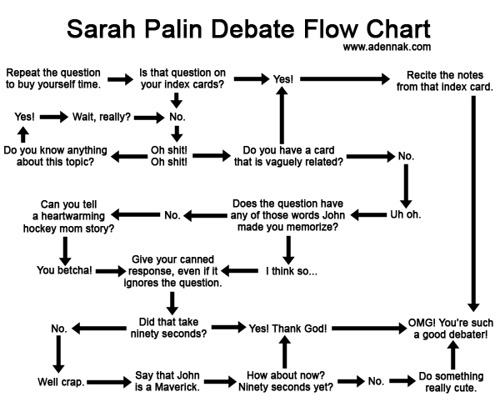
highlights from the vp debate


to make sense of the actual debate, here is a chart from palin's debate training that the press has acquired.


finally, here is an ap article about palin and mccain's new smear attacks on obama.

Saturday, October 04, 2008

for ang

as i lay awake and dream
of you a smile flows from my heart
and stretches across my lips.
these moments of thought fill my smallest eternities
and transform the world.
when the time arrives to face my day
i am gladdened and empowered
with the strength you give me.

Friday, October 03, 2008

sarah palin is a disney movie


sarah! sarah! sarah! sarah! sarah! . . . i mean . . . rudy! rudy! rudy! rudy!

when i first saw this movie, i remember feeling all inspired. wow. rudy is just like me. i want to be like rudy some day. rudy wasn't some notre dame insider, but rudy showed the world he was just as great as any of those experienced and trained players who deserved to be on the field.

that movie was so inspiring.

about a week later something hit me: rudy sucked at football. he was terrible. he wasn't qualified to play in that game. he shouldn't have been qualified to play in any football game. the moral of the story was that if you are really bad at something and keep on trying and failing at it, eventually people will feel sorry for you and give you a chance. if you don't completely screw up that one chance they give you, they'll treat you as if actually accomplished something important when in fact you didn't do a single thing.

cut to sarah palin. after last night's debate some are acting like she actually accomplished something major. some have been touting that she won the debate. really?

stop and think about it people.

the only thing sarah palin accomplished last night was that she managed to not completely make an utter fool of herself. she didn't win in any normal sense of the word. the only thing she beat was the pathetically low expectations everyone had of her. after her last few series of interviews she would have had to trip while walking onto the stage, fall flat on her face, and try to debate with a wad of toilet paper stuffed up her nose to plug up a nosebleed in order to drop below the bar she set for herself.

rudy at least managed to get a sack in his game. what did palin manage?

she dodged question after question, explicitly refusing to answer some. her logic (or lack of it) while addressing climate change were cringe-worthy. her constantly repeated campaign lines about 'change' and 'maverick' were quickly pointed out by biden to be hollow and meaningless - she had the audacity to criticize biden for talking about the past with the bush adminstration, not realizing that 'change' is meaningless without a context of what we are changing from. her stats were often either flat out lies or logically fallacious. she kept touting herself as an 'expert on energy' but failed to show she knew anything about it. and half of her criticisms she threw out against obama were logicallly critical of her own running mate - she criticized obama for voting against a bill for funding troops even though mccain did the same; she criticized obama for not wanting to drill more in alaska's protected forests even though mccain refuses to drill there as well; she criticized obama for votes for taxes that mccain also voted similarly on. it seemed like she got so caught up in the excitement of being in the spotlight that maybe she thought she was running for president.

for any of you that think she did a great job in the debate, give it some thought. read the transcript of the debate where you might be less enchanted with her cute-as-a-button looks and joe-just-like-us-six-pack demeanor. try to avoid her uses of darn it and other catchy colloquial phrases. check to see if she has any substance.

if palin had been anyone whose expectations weren't set so low, this debate would have been seen as a unanimous win by biden. if romney, lieberman, or anyone else had performed like palin nobody would have been saying they did a great job.

like rudy, you will discover that she is unqualified to be playing on the field. sure it might look fun and inspiring to see her running around excited to be allowed to play, but think about it. would you really want rudy actually playing on the team? do you want him on your defense when the game is on the line? are you going to take the risk of rudy playing backup when the starter gets injured?

no you don't.

matt damon was right.

god bless the american electorate

sometimes when i think about who we allow to choose our president i get really sad and worried.


http://view.break.com/580075 - Watch more free videos


thanks goes to jack for the video.